Methodology

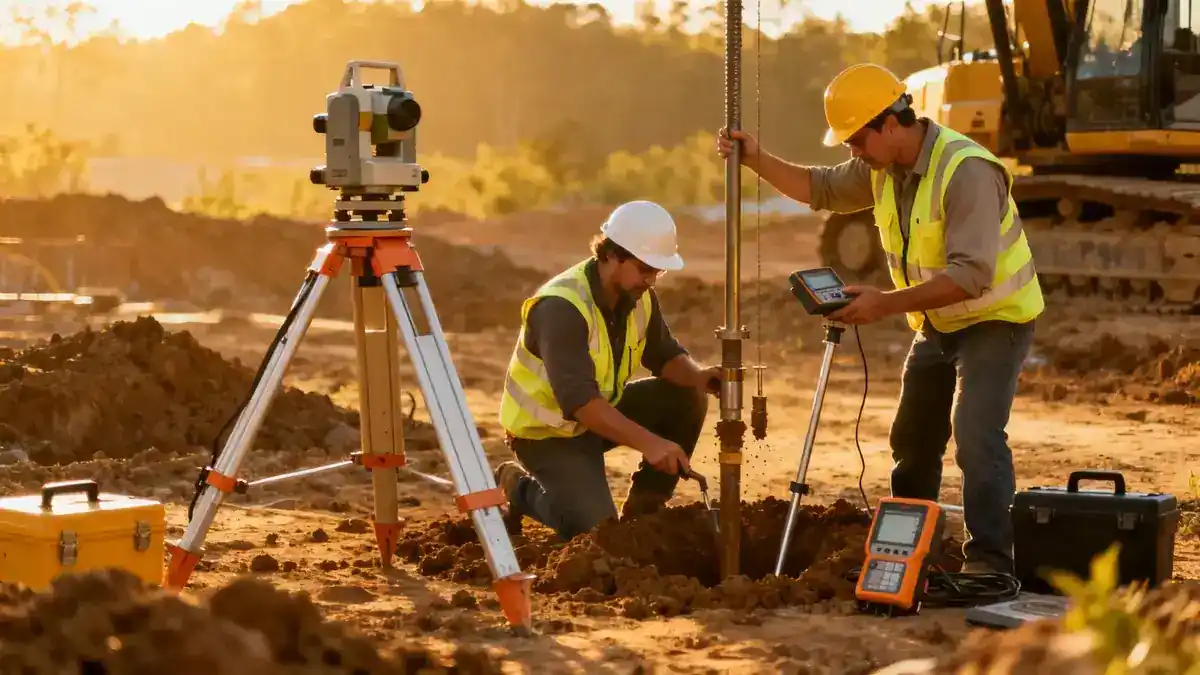
Our methodology for geotechnical engineering in Roseville California follows a systematic approach aligned with ASTM and local standards. We begin with a thorough review of existing geologic maps and nearby project data. Field investigations typically involve SPT boring at depths of 8 to 15 meters for residential projects, with sampling intervals per ASTM D1586. Laboratory testing includes classification, strength, and consolidation tests on representative samples. We then develop site-specific models to evaluate bearing capacity, settlement, and seismic site response, culminating in detailed reports with foundation recommendations.
Reference Technical Parameters
| Parameter | Reference Value |
|---|---|
| Predominant soil type | Silty clay and clayey sand (alluvial deposits) |
| Maximum seismic acceleration (PGA) | 0.4g (ASCE 7-16, Site Class D) |
| Typical groundwater level | 3 to 6 meters below ground surface |
| Bedrock depth | Greater than 30 meters (deep alluvium) |
| Typical N60 range | 4 to 15 blows per foot (soft to medium stiff clays) |
Local Considerations — Roseville California
Roseville California's geology is dominated by Quaternary alluvium from the Sierra Nevada foothills, with soil profiles consisting of interbedded silty clays, sands, and gravels. Expansive clays are common, requiring careful moisture management and specialized foundation design. Seismically, the region is influenced by the Foothills Fault System, yielding peak ground accelerations up to 0.4g per ASCE 7. Groundwater levels fluctuate seasonally, often encountered at 3–6 m depth. New developments in areas like West Roseville often face deeper fill soils, while infill projects near downtown deal with variable undocumented fills. Our team applies local experience to these challenges, coordinating with soil mechanics laboratory testing for site-specific solutions. For broader regional context, see geotechnical engineering en Los Angeles.
Request a Quote
Our team reviews your project and issues an initial report at no cost.
Or write us directly at [email protected]
Services in Roseville California
Applicable Standards
- ASTM D1586 (Standard Penetration Test)
- ASCE 7-16 (Minimum Design Loads for Buildings)
- California Building Code (CBC 2022)
- Placer County Grading and Erosion Control Ordinance
Frequently Asked Questions
What are the typical soil types encountered in Roseville California?
Soils in Roseville California are predominantly alluvial silty clays and clayey sands, often with expansive characteristics. These deposits can vary significantly over short distances, necessitating thorough subsurface exploration for each site.
Is seismic analysis required for projects in Roseville California?
Yes, due to moderate seismic hazard from nearby fault systems, the California Building Code requires site-specific seismic response analysis for most structures. This includes determining site class and calculating design accelerations per ASCE 7.
Are geotechnical investigations mandatory for residential construction in Roseville California?
While not always legally required for single-family homes on stable lots, many local jurisdictions and lenders recommend or require geotechnical reports, especially for hillside sites, expansive soils, or when deep foundations are needed.